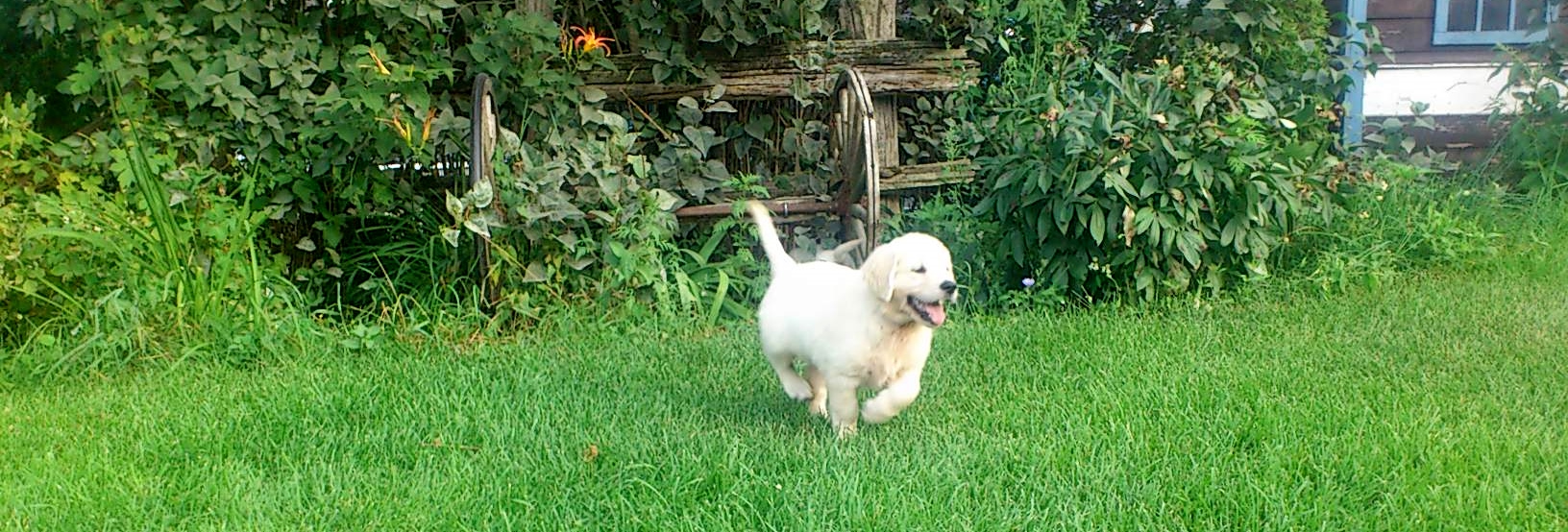
How much sleep does a puppy really need?

Everything You Need to Know About Your Goldens Sleep
Congratulations on your new Whispering Willow puppy! Sleep is one of the most important
ingredients for a happy, healthy golden. This guide will walk you through everything you
need to help your puppy rest well — from day one through their first birthday and beyond.

1. Age-by-Age Sleep Requirements

Understanding how much sleep your puppy needs at each stage is key to keeping them healthy and well-adjusted. Use this table as a handy reference:

Age Total Sleep Needed (per 24 hrs) Notes
8–10 weeks 18–20 hours Puppies at this age sleep almost constantly — this is normal and essential for development. Expect very short awake windows of 30–60 minutes.
10–12 weeks 16–18 hours Slightly longer awake periods emerge. Naps are still frequent and vital.
3–4 months 14–16 hours Your puppy will begin to consolidate naps. Awake windows grow to 1–2 hours.
5–6 months 12–14 hours Sleep patterns start resembling an adult schedule. Expect 2–3 naps plus overnight sleep.
6–12 months 10–14 hours Adolescent puppies may resist naps but still need them! Watch for overtired signals.
Adults (1+ year) 12–14 hours Most adult Goldens settle into a predictable routine of overnight sleep plus daytime naps.
📝 A Note from Us
Every puppy is different — these are guidelines, not rigid rules. If your puppy is sleeping a bit more or less, that’s usually perfectly fine. When in doubt, reach out to us!

2. Sample Daily Schedule

Here’s a suggested daily routine for a 10-week-old puppy. Notice the pattern: potty → activity → nap, repeated throughout the day.

Time Activity
6:30 AM Wake up & potty break outside
6:45 AM Breakfast (in crate or feeding station)
7:00–7:30 AM Gentle play & socialization
7:30–9:30 AM Morning nap (crate or pen) 💤
9:30 AM Potty break
9:45–10:15 AM Short training session & exploration
10:15 AM–12:00 PM Mid-morning nap 💤
12:00 PM Potty break & lunch
12:30–1:00 PM Play & socialization
1:00–3:00 PM Afternoon nap 💤
3:00 PM Potty break & short play
3:30–5:00 PM Late afternoon nap 💤
5:00 PM Potty break & dinner
5:30–6:15 PM Evening play, gentle training, or family time
6:15–7:30 PM Evening nap 💤
7:30 PM Final potty break & calm wind-down
8:00 PM Bedtime in crate 🌙
💡 Tip
This is a flexible template — adjust times to fit your household rhythm. The key pattern is: potty → activity → nap, repeated throughout the day.

3. Overtired vs. Undertired — Know the Signs

One of the biggest challenges for new puppy owners is figuring out whether your puppy needs more sleep or more activity. Here’s how to tell the difference:

😫 Overtired Puppy Signs

  • Biting and mouthing more than usual (the “witching hour” nipping)
  • Zoomies that seem frantic or out of control
  • Refusing to settle, even when clearly exhausted
  • Whining, barking, or crying for no obvious reason
  • Glazed or “wild” eyes
  • Ignoring commands they normally follow
  • Becoming increasingly rough during play

⚡ Undertired Puppy Signs

  • Restless in the crate, pacing or unable to settle
  • Whining or barking when put down for a nap
  • Destructive chewing or digging
  • Demand barking at you for attention
  • Difficulty falling asleep at bedtime
  • Excessive energy that doesn’t wind down after play
💡 Golden Rule
When in doubt, your puppy is probably overtired, not undertired. Golden Retriever puppies almost always need more sleep than owners expect!

4. Crate Training Mini-Guide

A crate isn’t a cage — it’s your puppy’s personal den. When introduced properly, most Golden puppies learn to love their crate. Here’s how to set your puppy up for success.

Choosing the Right Crate

  • Type: Wire crates with divider panels are ideal for growing Golden puppies.
  • Size: Large enough for your adult Golden (42″ recommended), with a divider to make it puppy-sized now.
  • Placement: A quiet but not isolated area — your bedroom at night, a family room during the day.

Steps to Crate Success

  1. Make it cozy — Add a soft bed or blanket, and optionally a crate cover to create a den-like feel.
  2. Create positive associations — Toss treats inside, feed meals in the crate, offer a stuffed Kong.
  3. Start with the door open — Let your puppy explore freely without closing the door at first.
  4. Close the door briefly — Start with just a few seconds, then 30 seconds, then a minute. Stay nearby.
  5. Gradually increase duration — Build up to 5 minutes, then 10, then 20. Step out of sight briefly.
  6. Add a cue word — Use a consistent phrase like “crate up” or “go to bed.”
  7. Never use the crate as punishment — The crate should always feel like a safe, happy place.

Crate Do’s and Don’ts

  • ✅ Do keep the crate near you at night for the first few weeks
  • ✅ Do take your puppy out for potty immediately after crate time
  • ✅ Do offer a safe chew toy in the crate
  • ✅ Do cover the crate partially to reduce stimulation
  • ❌ Don’t let your puppy out when they’re whining (wait for a pause)
  • ❌ Don’t leave a young puppy crated longer than 2–3 hours during the day
  • ❌ Don’t put a collar on your puppy inside the crate (safety hazard)
  • ❌ Don’t force your puppy into the crate — lure with treats instead

5. Common Mistakes New Owners Make

Don’t worry — every new puppy owner makes a few of these. Here’s what to watch for and how to fix it:

1. Not enforcing naps

Puppies won’t self-regulate sleep. If your puppy has been awake for an hour, it’s probably nap time even if they seem energetic.

Fix: Use “enforced naps” in the crate on a schedule.

2. Too much freedom too soon

Giving a new puppy full run of the house leads to overtiredness, accidents, and destructive chewing.

Fix: Use a crate, pen, or tethering system.

3. Responding to every whine

Opening the crate every time your puppy cries teaches them that crying = freedom.

Fix: Wait for a quiet moment (even 3 seconds) before opening the crate door.

4. Skipping the bedtime routine

Puppies thrive on predictability.

Fix: Create a consistent wind-down routine: potty, calm time, crate.

5. Overtiring before bed

Vigorous play right before bedtime amps your puppy up.

Fix: Keep the last hour before bed calm and quiet.

6. Expecting them to sleep through the night immediately

Most puppies need 1–2 overnight potty breaks until around 14–16 weeks.

Fix: Set an alarm, take them out quietly, and put them right back.

7. Making middle-of-the-night potty trips fun

Talking, playing, or turning on lights during nighttime outings signals “party time.”

Fix: Keep it boring — minimal light, no talking, straight back to the crate.

8. Comparing your puppy to other puppies

Every puppy develops at their own pace.

Fix: Focus on your puppy’s progress, not someone else’s timeline.

6. Sleep Regression — What to Expect

Just when you think you’ve got this sleep thing figured out… your puppy may hit a rough patch. Don’t panic! Here’s what’s happening and what to do about it.

What Is Sleep Regression?

Around 4–6 months, many puppies who were sleeping well suddenly start waking at night, resisting naps, or crying in the crate again. This is sleep regression — and it’s completely normal.

Why Does It Happen?

Teething discomfort, adolescent brain development, growing independence, and sometimes a growth spurt all converge during this stage. Your puppy’s brain and body are going through enormous changes.

How Long Does It Last?

Typically 2–4 weeks, though some puppies have brief flare-ups for a few months.

What to Do

  • Stay consistent with your routines — don’t abandon the crate or nap schedule
  • Offer frozen chew toys for teething pain
  • Ensure enough exercise — both physical AND mental stimulation during awake windows
  • Avoid adding new sleep crutches (like letting them into your bed) that you’ll need to undo later
  • Be patient and compassionate — they’re not being “bad,” they’re growing
🌿 Reassurance
Sleep regression is a phase — not a permanent personality change. Stick with your routine, give your puppy grace, and it will pass.

7. Troubleshooting Chart

Quick reference for common sleep issues — find your problem in the left column and try the suggested solution.

Problem Possible Cause Solution
Puppy cries in crate at night Too far from you; needs potty; not tired enough Move crate to your bedroom; take out for a quick potty break; ensure adequate daytime exercise
Puppy won’t settle for naps Overtired or overstimulated Enforce nap earlier next time; cover the crate; use white noise
Puppy wakes up too early Light or noise; hunger; needs potty Use blackout curtains; feed a slightly later dinner; take out quietly then return to crate
Puppy sleeps all day but is restless at night Day/night confusion; not enough daytime activity Ensure awake windows include play and training; keep daytime naps in natural light
Puppy suddenly resists the crate Negative association; teething; regression Go back to basics with treat-loading; check for teething pain; stay consistent
Puppy naps only when held Over-reliance on contact napping Gradually transition to crate naps using a worn T-shirt for scent comfort
Puppy is frantic after naps Normal post-nap energy burst Take immediately outside for potty then allow brief play before next activity
Puppy won’t sleep unless exhausted Missing enforced nap routine Don’t wait for signs of tiredness — put them down proactively on a schedule

8. Safe Chew & Comfort Items for Sleep Time

The right items in the crate can help your puppy settle faster and stay content. Here’s what’s safe — and what to skip.

✅ Safe Choices

  • Stuffed and frozen Kong — stuffed with peanut butter, pumpkin, or soaked kibble
  • Nylabone puppy chews — age-appropriate sizes
  • Benebones — puppy version
  • West Paw Zogoflex toys — dishwasher-safe, durable
  • Snuggle Puppy with heartbeat — great for the first few weeks
  • A worn T-shirt or small blanket with your scent
  • Lick mats — can be attached to the crate wall

❌ Avoid in the Crate

  • Rawhide chews — choking hazard
  • Bully sticks — only give these supervised, never in the crate
  • Stuffed animals with small parts or squeakers that can be torn off
  • Rope toys — can unravel and cause intestinal blockage
  • Anything small enough to swallow whole
  • Collars, harnesses, or tags — strangulation risk
💡 Safety Tip
Always supervise your puppy with a new chew toy the first few times to make sure they’re using it safely. Once you’re confident, it’s fine for crate time.

We’re always here to help!If you have questions about your puppy’s sleep — or anything else — don’t hesitate to reach out to us at Whispering Willow Goldens.Sweet dreams to you and your new golden baby!

🐾